Nation · Angola
Union of Indigenous Peoples of Huila
An organisation of Indigenous Peoples from the south of the Republic of
Angola, based in the province of Lubango – part of the Great Platform
Council of Elders of Kama (C.SA.K).
Rooted in the red earth of Huila
The Union of Indigenous Peoples of Huila is an organisation of Indigenous Peoples from the south of the Republic of Angola, based in the province of Lubango. Our organisation is part of the Great Platform « Council of Elders of Kama Asbl », a non-profit association under African law, bringing together non-governmental organisations, development associations, human rights defenders, as well as discriminated indigenous communities.
The history of the Huila People
The history of the region and of the Huila People is shaped by migratory waves and ethnic intermingling. The San, the first inhabitants of the territory, still live there in small nomadic groups.
In the 17th century, the Mwila settled there after a drought, originating from the mixing of invaders from the east and local populations. From this fusion emerged a powerful kingdom, led by a local chief, which lasted until the 19th century.
These communities, often referred to as Nyaneka-Humbe, live off agriculture and cattle rearing. Today, a work of remembrance is being carried out to preserve their cultural heritage, notably through exhibitions, in order to contribute in some way to the fight against the mental and spiritual alienation resulting from colonial and post-colonial history.
In summary, the history of Huila is one of ancient intermingling, a kingdom, colonial resistance, and a memory still very much alive, carried by the San, the Mwila and the Nyaneka.
The birth of a Union – Heart to heart, land to land
In November 2025, on the red earth of Huila, in Angola, a people ceased to be a shadow. That day, the Union of Indigenous Peoples of Huila was born. Not from a clap of thunder, but from a long inner murmur, carried by the elders, the women and the young who knew that their identity was not a dusty memory, but a living force to be reinvented.
„This work of remembrance is called ethnogenesis: a people who choose themselves, who weave their own bonds, who reaffirm ‚we‘ with pride.“
Before the Union, there was the association „Indigenes Volk Germaniten“, a cradle where this identity was forged, rooted in the law of peoples but above all in the word of the ancestors. Then came the time to reach out to the world. The elders of the Council of Elders of Kama (C.SA.K) took the step, with the dignity of those who have nothing to prove but everything to pass on.
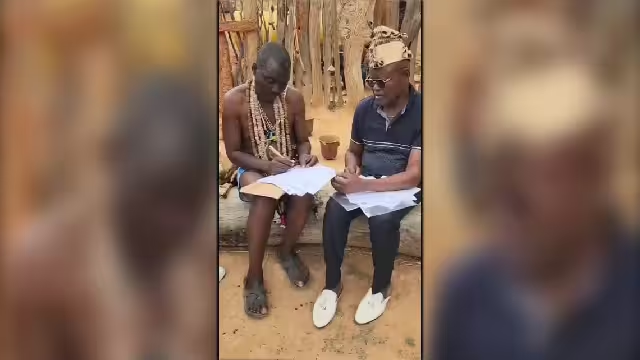
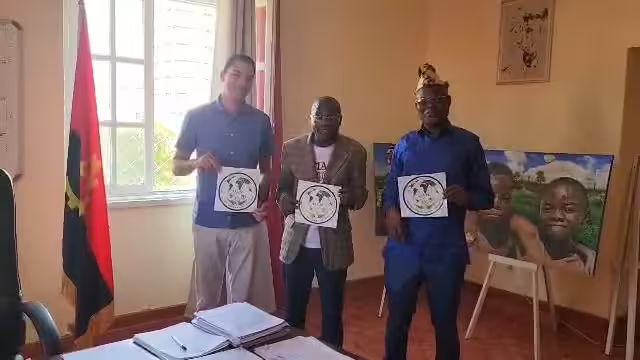
In November 2025, in Huila, they sealed agreements with the Union of Indigenous Nations (U.I.N.). Beneath the signature, there was not merely an administrative act. There was a recognition: this people exists, it has rights, a land, a history and a future.
„Today, the Union stands tall. It was not born of paper, but of a breath. That of women and men who said ‚enough‘ to erasure and ‚yes‘ to their own light.“
And this breath, they pass on to their children, so that memory may never fade and the land of Huila may never be forgotten.
Who we are not, and our legal foundations
Who ore what ae we not?
- Not a closed ethnicity –our identity opens itself to those who walk with us.
- Not rigid traditionalists – our wisdom is alive and forward-looking.
- Not passive victims – we are the primary actors in our own survival.
- Not mere guardians of an exotic nature – we are a complex people, herders, farmers, fathers and mothers.
- Not without voice or organisation – we have our elders, our assemblies and our own strategies.
- Not scattered or without memory – we have a collective project: to pass on a living land to our children.
Legal Foundations
The U.I.P.H. bases its existence and its action on a legal framework which, although rooted in Angolan reality, is articulated with the principles of the platform Council of Elders of Kama (C.SA.K). Given the legal restrictions of our country, we have not yet acquired a legal personality which would allow us to operate both within and outside the country; however, the procedures are still ongoing.
- Constitution of the Republic of Angola (CRA):
The U.P.I.H. bases its action on the constitutional principles which guarantee fundamental rights, notably freedom of association, as well as the recognition of the legal value of customary norms and traditional authorities, provided that they respect constitutional principles. The Angolan State has a duty to ensure the democratic participation of citizens and civil society, which legitimises the existence of organisations such as the U.P.I.H.
- Ordinary Angolan legislation:
Although there is no specific law for „indigenous peoples“, the U.P.I.H. acts within the framework of a natural functioning of actually existing communities. The community dynamic functions and places itself above the laws of the state because it is natural, given that the existence of a community is a natural reality. The principles of democratic organisation, use of peaceful means and accountability, which govern associations in Angola, are applicable to its structure and its functioning.
- By-laws and Internal Regulations of the U.I.P.H.:
They constitute the fundamental documents which govern its creation, its objectives, its organic structure and its internal functioning, defining its nature, the composition of its members and the rules for decision-making. All these documents exist but have not yet been endorsed for the reasons mentioned above.
- Integration into the C.SA.K platform:
As a member of the Council of Elders of Kama (C.SA.K), the U.P.I.H. benefits from the legal foundations of this platform, which include: the official documents of the founding member structures, which serve as a basis for joint action. We recall that these documents exist but have not been notarised by the Angolan administration. A future Charter, of a regulatory nature, which will define the functioning of the platform.
Although the C.SA.K is a legal entity in the Democratic Republic of the Congo, the U.I.P.H., located in Angola, operates within the framework of Angolan legality, while taking advantage of the structure and the transnational influence of the platform.
A struggle for water, land and dignity
Our community is today experiencing one of the hardest trials in its history. Day after day, we face a reality that tightens our hearts: droughts, increasingly frequent and violent, descend upon our lands like a silent curse.
They dry up our rivers, burn our crops, and gradually turn our pastures into dust. It is not only the earth that cracks, it is our entire life that is weakened.
Our pastoral and agro-pastoral systems, so resilient in the past, are faltering under the weight of this aridity which yields nothing.
„We are not only losing means of subsistence; we risk losing our bond with the land that saw us born, with our traditions, with our common future. But even at the heart of this ordeal, we refuse to give up.“
We are seeking solutions, we are standing together, we are drawing on our ancient and new strengths to resist. For if the challenges are immense, our will to live, to share and to pass on is equally so.
Learn more about the U.I.P.H. and its work
Discover the history, the culture and the struggles of the
Indigenous Peoples of Huila in the south of Angola.