Nation · A.P.I.A.B.
Association of Indigenous Peoples of Babongo
One of the indigenous peoples of Gabon, often referred to as "Pygmies" –
known for their intimate knowledge of the forest and their vital role in
traditional rituals, particularly the Bwiti.
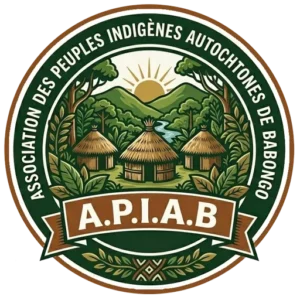
One of the indigenous peoples of Gabon
We are one of the indigenous peoples of Gabon, often referred to as „Pygmies“. Found in several regions of the centre and south of the country, we are known for our intimate knowledge of the forest and for the vital role we play in traditional rituals, particularly the Bwiti.
Of all Gabon’s indigenous communities, we occupy the largest territory. We are found throughout the country.
„Our history is alive, and our traditional knowledge evolves alongside us.“
The History of the Indigenous People of Babongo
Our history is that of a people who have gradually changed their way of life without ever quite leaving the forest. For a long time, we lived as semi-nomads, moving with the seasons, following the rhythm of hunting, gathering and fishing. We cultivated the land a little, but not enough to live on. The rest came from trade with our farming neighbours, particularly the Massango.
These relations were based on a long-standing balance: we contributed our labour and the forest’s produce, whilst the Massango supplied us with food. The ties between the two communities were also forged through rituals, in which we took part, even though, in day-to-day life, each group remained separate.
In the mid-20th century, the Gabonese government encouraged people to settle along the roads. The Babongo then abandoned their nomadic way of life and settled in villages, often near the Massango. Gradually, they adopted the Massango’s language, kinship system and rituals. Farming became more prominent, and marriages between the two groups became commonplace.
„As for the forest, it has never disappeared from their horizon. Many still have a village by the roadside, whilst others spend part of the year in camps, particularly during the dry season.“
Hunting, gathering and fishing continue to provide for their families. This flexibility has enabled them to navigate change without losing their way. They remain hunter-gatherers in a world of farmers to which they now belong.
Establishment of A.P.I.A.B. and its membership in the U.I.N.
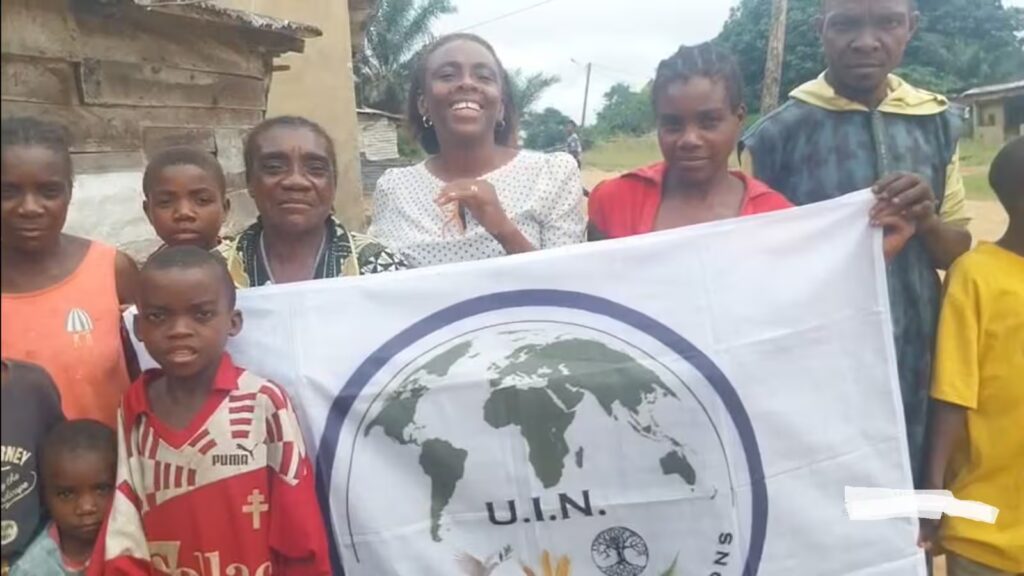
On 3 April 2026, in Gabon, the Babongo ceased to be a shadow. On that day, buoyed by their membership of the broad-based platform of the Council of Elders of Kama (C.S.A.K) and by their experience in community organisations, they sealed historic agreements with the Union of Indigenous Nations (U.I.N).
„The signing represented not merely an administrative act, but a profound recognition: that of a people who exist, who hold rights over their ancestral lands, who possess a rich history, and who intend to build their own future.“
This membership did not come out of nowhere. It is the culmination of a long process of preserving memory and building organisational structures led by the elders, women and young people, all of whom refuse to be erased or socially marginalised.
Their journey within the C.SA.K has enabled them to forge bonds of solidarity with other Indigenous peoples of Central Africa, to strengthen their voice and to prepare for this decisive moment when they chose to say ‘yes’ to their own light, to their unique forest knowledge and to their rediscovered dignity.
Today, the Association of the Indigenous People of Babongo (A.P.I.A.B.) stands firm. It was not born of a mere piece of paper, but of a spirit passed down from generation to generation.
This spirit – that of the men and women who said ‘enough’ to invisibility – they now entrust to their children, so that the memory may never fade, so that the forest of their ancestors may never be forgotten, and so that their dignity may never be called into question. This membership of the U.I.N marks a new beginning: one of hope for recognition, paving the way for rights that are finally respected and a history that is finally written in their own hands.
What we are not
We are not a people stuck in the past
our history is alive, and our traditional knowledge evolves alongside us.
Not mere participants in rituals
We are men and women standing tall: healers, hunters, gatherers, craftspeople, parents.
Not resigned victims
We remain the primary custodians of our knowledge and the primary architects of our future.
Not without a vision
We want to pass on to our children our connection to the forest, our dignity and our place in this changing world.
Not asking for charity
We are asking for respect, recognition and the right to decide for ourselves.
Not an exotic image
We are far more than an exotic image or a myth fabricated at our expense.
Legal foundations of the A.P.I.A.B.
The representative organisation of the Indigenous People of Babongo, an indigenous community of the Gabonese equatorial forest, bases its existence and activities on a legal framework rooted in the reality of the Gabonese Republic, in line with the principles of international instruments relating to the rights of indigenous peoples.
The Gabonese Constitution and general principles
The Babongo people’s campaign is based on constitutional principles that guarantee fundamental rights, in particular freedom of association, equality before the law and the prohibition of discrimination on the grounds of origin.
As the Gabonese Constitution makes no formal distinction between „indigenous“ and „non-indigenous“ people, the Babongo’s demands centre primarily on non-discrimination, equitable participation and the protection of cultural heritage.
The government is obliged to guarantee the exercise of freedom of association, and Gabon has affirmed before international bodies that its public policies must include all sections of the population without distinction.
Sector-specific legislation and national policies
In the absence of a specific law relating to indigenous peoples, several sector-specific pieces of legislation provide the Babongo with practical avenues for participation:
- Forestry Code and community forests – a community forest is defined as a portion of the forest estate allocated to a village community, with the aim of making local communities, including indigenous communities, the main actors in sustainable management. Since 2013, management agreements have enabled Babongo communities to participate in forest management and the sharing of benefits; however, in practice, this is not being implemented.
- Complaints handling – in protected areas home to indigenous villages, committees receive and address residents’ grievances, ensuring their effective participation at every stage.
- Sharing of mining revenues – the 2019 Mining Act provides for the distribution of revenues between the State and a local community development fund, offering the Babongo a legal channel for sharing the benefits, from which they unfortunately do not benefit.
International instruments and regional mechanisms
- UNDRIP – Gabon has committed to working towards its implementation, recognising the rights of indigenous peoples to self-determination, to their lands and resources, and to the preservation of their culture.
- African Charter on Human and Peoples' Rights – ratified in 1986, it guarantees every person the enjoyment of recognised rights, without distinction, as well as equality before the law. The African Commission’s Working Group on Indigenous Peoples has recommended that Gabon recognise the traditional way of life of ‘Pygmy’ peoples and protect their access to land, forests and natural resources.
- ILO Convention No. 169 – although not ratified by Gabon, its principles – prior consent, land rights and cultural integrity – nevertheless serve as a reference point for Babongo organisations in their advocacy work.
The practical basis and legitimacy of organised action
The Babongo people may organise their activities through duly registered associations, cooperatives or community groups. The African Commission has recommended that Gabon issue indigenous organisations with permits to form associations for an indefinite period. At the local level, the Babongo share the mwiri initiation rite with the Massango, in which the participation of the two groups is broadly equal, providing them with a basis for participation in local decision-making.
However, a structural inequality remains: the Babongo do not generally own the land they occupy, as it belongs to the Bantu, which exposes them to a constant risk of eviction. This reality is the central basis for their land claims. Ultimately, the legal foundations of the Babongo people rest on the constitutional principles of equality, the mechanisms for community participation provided for under forestry and environmental law, and international instruments for the protection of human rights.
In the Gabonese context, where there is no specific legislation, these elements form an integrated legal strategy, embedding indigenous claims within the framework of ordinary law and the international commitments already undertaken by the State.
The difficulties faced by the Indigenous People of Babongo
We are facing difficulties that affect virtually every aspect of life. These are not new, and they reinforce one another.
Lack of official documents
Many Babongo have neither a birth certificate nor an identity card. Without these documents, they do not exist in the eyes of the authorities. We cannot vote, nor can we easily access healthcare or enrol our children in schools. This problem is perpetuated by dubious political practices: some candidates hand out birth certificates during election campaigns, only to take them back once the vote is over. Added to this is the fact that many women give birth far from maternity hospitals, often because the nearest facility is too far away.
Access to school and healthcare
In many Babongo villages, there are no schools at all. Where there is one, it is sometimes more than ten kilometres away. And even when a school is available, families cannot afford the enrolment fees or school supplies. The children are then sent home, sometimes for good. As for healthcare, the situation is hardly any better: health centres are far away, and poverty prevents people from accessing them.
Political invisibility
Our settlements are often regarded as mere neighbourhoods attached to a village led by a Bantu chief. We have no local councillors, no MPs, nor any civil servants from our own community. As a result, our needs and rights are rarely taken into account in decisions that affect us.
Settling down has also undermined our autonomy. In the past, the forest was enough for us. Today, we are increasingly dependent on our Bantu neighbours. We exchange our labour or our forest products for food, often under unfair terms. Logging and conservation projects are reducing our access to hunting and gathering grounds and to medicinal plants. And the income from timber is not shared fairly with us.
„Finally, there is the issue of land. We Babongo have no land titles. We have occupied and used these forests for generations, but there is no official recognition of this.“
As the civil servants are almost all Bantu, we are in a poor position to put forward our claims. All of this creates a vicious circle. No documents, so no school. No school, so no skilled employment.
Learn more about the A.P.I.A.B. and its work
Discover the history, the culture and the struggles of the Indigenous People of Babongo in the equatorial forest of Gabon.